Showing posts with label Barolo. Show all posts

Sunday, October 10, 2010

Looking for Piemontese Terroir

Enough talk (1,2) about Barolo and Barbaresco, it is time to tell you how the tasting went.

So, was our group of five tasters, blinded, able to correctly divine the thread of terroir in this small selection of top Piemontese offerings? Well, no. In fact none of our group paired the two Barolos and two Barbarescos together, although two of us put the 1998 and 2000s together. (does vintage trump terroir in Piemonte?)

But there was no disappointment tonight, as we collectively enjoyed some tremendous wines:

On our left was the 2000 Sandrone Barolo Cannubi Boschis. A nose of sour cherries, vanilla and some metallic notes, the fruit turning darker as the wine opened up...but always delicate and light, somewhat reserved vs. other Sandrone Barolos I have tasted. Dry, sour cherries mingled with fine tannins on the palate - delicate and very well balanced, yet with tremendous length and presence. Such elegance could only be the product of Luciano Sandrone.
14.5% alcohol, Score: 18/20

The 1998 Marchesi di Barolo Sarmassa was a revelation. Enjoyed previously, but I didn't expect it to show so well amongst such illustrious peers. A nose of vanilla and black cherries, roses, a dash of black pepper and metallic notes (characteristic of both barolos tonight). Silky smooth with substantial tannins and a beautiful, never-ending finish. Bravo! (I thought it was a Barbaresco)
14.5% alcohol, Score: 18.5/20

Another terrific effort tonight was the 1998 Prunotto Barbaresco Bric Turot. Very flinty on the nose, with vanilla and cinnamon, some tar and black pepper ... late appearing notes of almonds and cooked cherries signalled an older wine. Very dry, with soft velvety tannins and a slight metallic aftertaste. A beautiful long finish, simply gorgeous, and very Barbaresco.
13.5% alcohol, Score: 18/20

The 2000 Moccagatta Barbaresco Bric Balin was the odd wine of the evening, and the only one everyone was completely wrong on. A stark nose - tarry, very tarry in fact, with noticeable oakiness, black earth, tobacco and cheese rind. While the first three wines were tremendously polished, the Moccagatta was tart, tannic and harsh, kinda "in your face". Crisp, with a very, very, long finish - it certainly has the acid and the tannins for aging - I think I will open my other bottle in another 10 years.
14% alcohol, Score: 17.5/20 So we didn't find terroir tonight, as the relative harshness of the Moccagatta screamed "young Barolo" and left everyone looking elsewhere for Barbaresco. Tonight I paired the 1998s and the 2000s together, which made me think that our research would have been better served by removing a variable and pouring wines from the same vintage...

Finally, I should mention the 2001 Pio Cesare Barbera "Fides" that served as our "starter wine" tonight, beautiful, as always (1,2).

Tuesday, October 05, 2010

Fast Facts: Barolo and Barbaresco

Source: Consorzio di Tutela Barolo Barbaresco Alba Langhe e Roero

Despite the near legendary status of these Piemontese wine regions, it is actually very difficult to find good stats in books or on the web. Just as these monstrous wines are slow to reveal their secrets, so too is the producer consortium, it appears, which seems ok with an Italian-language only website...

Hopefully these quick facts will save you some searching:

Barolo
(awarded DOC in 1966, promoted to DOCG in 1980)
Langhe hills southwest of Alba
Eleven communes: Barolo, La Morra, Monforte d'Alba, Serralunga d’Alba, Castiglio Falletto, Novello, Grinzane Cavour, Verduno, Diano d’Alba, Cherasco, Roddi
Varieties: 100% Nebbiolo
Vineyard Area: 1714 ha / 4286 acres
Production: 10 million bottles
Aging: Three years minimum (at least two years in oak), five years for Riservas

Barbaresco
(awarded DOC in 1966, promoted to DOCG in 1980)
Rolling hills east and northeast of Alba
Three communes: Barbaresco, Neive, Treiso
Varieties: 100% Nebbiolo
Vineyard Area: 680 ha / 1680 acres
Production: approx. 2.5 million bottles
Aging: Two years minimum (at least one year in oak), four years for Riservas

Soils in the Barolo/Barbaresco region are predominantly limestone-rich marls. Note that there are over 800 producers in the two regions, with an average vineyard size of just 5 acres, and average annual production of just 10,000 bottles!

Sources: Oxford Companion to Wine, Vino Italiano, Wikipedia and other

(PS - consider this post a work in progress - please feel free to share any sites/books that could fill in some additional details)

Wednesday, September 29, 2010

Barolo and Barbaresco, What's the Difference?

Source: Wikipedia

Are Barolos and Barbarescos perceptibly different? Shouldn't the same grape (Nebbiolo), grown in appellations less than 20km apart, produce nearly indistinguishable wines? This Friday I once again seek to answer the question I posed more than two years ago - is there a defining difference between these wine regions?

Most books and web sites describe the wines made from the earlier-ripening (typically) Barbarescos as softer, elegant, more approachable. I like Bastianich/Lynch's comment in Vino Italiano, The Regional Wines of Italy:

Traditionally, Barbaresco was thought of as finer and more feminine than Barolo, the "queen" to Barolo's "king."

Most other writers feature a similar line of broad characterization - Barolos are heavier, more tannic, and require more cellar time to soften up, while Barbarescos are more approachable, perfumey, refined.

Of course, these comments are generalizations - with a plethora of producers working miniscule plots (not to mention different techniques in the winery) is it truly possible to define "Barolo-ish"? And will our small sample of '98 and '00 bottlings from Barolo and Barbaresco (four bottles) give us enough information to find that "sameness"? (Or will we simply drink a lot of wine)

I will let you know after Friday....

Saturday, February 23, 2008

Barolo vs. Barbaresco: Looking For Piemontese Terroir

In stark contrast to my Twelve Under $12 series was a towering wine tasting featuring some of the greatest, and priciest, wines of Piemonte. Our wine group went deep into our cellars to deliver the following, a mind blowing list of wines for Nebbiolo fans:

1996 Gaja Barbaresco
1996 Sandrone Cannubi Boschis
1997 Giuseppe Cortese Barbaresco Rabajà
1998 Prunotto Barbaresco Bric Turot
1998 Marchesi di Barolo Cannubi
1999 Sandrone Barolo Le Vigne
1999 Pio Cesare Barolo
2000 Paitin Barbaresco Sorì Paitin

Just to set the stage, our group's themes have rotated through the world's wine grapes and regions, but with a good basic command of the world's wines I now want to go deeper, really focusing on technique and terroir. With this in mind I "strongly suggested" that our next tasting dive deeper into a specific region, resulting in this high-end nebbiolo tasting to compare and contrast the wines of Barolo and Barbaresco.

Now, before I go into my review I want to highlight that it was extremely difficult to properly assess the wines - with 14 tasters, 10 decanters, 12 different wines (yes, there are eight above, but like all great athletes we needed to "warm up" for the big event and "cool down" afterwards) and 100 glasses (including water glasses) pressed into service, this was more of a wine party than a structured tasting, the assessment further complicated by one ounce pours of wines that needed hours to develop. In that context I reluctantly publish both my scores and the overall ranking by the group - here are my notes:

My two highest scores were for Cosme's 1996 Sandrone (fifth place) and the 2000 Paitin Barbaresco (seventh), both scoring 19/20. Once again, a Sandrone Cannubi Boschis wowed me with extraordinary depth and complexity - first showing a modern-styled nose of creamy cola notes, then bursting forth with classic cedar, musk, truffle, dark earth and rose. So soft and velvety smooth with dry dusty tannins, reserved fruit and seemingly infinite length. I was nearly alone in my praise for the Paitin Barbaresco - musk, leather, nutmeg, flowers and a late developing nutty smell were the olfactory foundation for a complex and beautifully textured wine, the very long finish hinting of many pleasurable years to come.

My next two highest scores were for Ash's Sandrone Barolo Le Vigne (first) and Chris' Giuseppe Cortese Barbaresco (eighth), both scoring 18.5/20. The Sandrone Le Vigne was very different, with inky vanilla and spicy nutmeg and cloves, but the highlight was a fine, well structured palate with silky tannins and gorgeous mouthfeel - the crowd favourite by a wide margin. The Cortese Barbaresco was another wine loved by Joe but disliked by the rest of the gang - very tarry on the nose, with nice secondary aromas from aging, hints of cumin, truffle, leather, venison, coffee and prunes. Very elegant, wrapping the palate in soft velvet and a never-ending finish...no idea why I was the only one who liked this.

My notes have three wines scoring 17.5/20: Cosme's Gaja Barbaresco (third), Lloyd's Prunotto Barbaresco Bric Turot (second), and my Marchesi di Barolo Cannubi (fourth). My Gaja rating probably stands out given the legend surrounding this estate, but this is the second Gaja Barbaresco that left me kind of flat. More floral on the nose, with musk, pepper, tar and cola notes. Elegant and balanced on the palate, with dry dusty tannins lengthy finish, but a bit thin and "hot". The Prunotto was tarry and flinty, with hints of cola and liquorice, but with less length and complexity vs. the other wines - very smooth and elegant, though. My Marchesi Cannubi was perhaps a touch less polished but more interesting than the two above - meaty prunes, cherry fruit, rose, truffle, leather and an odd industrial note that I couldn't quite place. Edgy, but interesting.

I scored Cam's Pio Cesare Barolo (sixth) last, score: 17/20. Pale cola and vanilla notes, but not much else on the nose. Edgy on the palate, to quote: "modern, simple, easy drinking".

Editorial:

(1) While not quite addressing my personal objective to define more clearly for me the difference between a Barolo and a Barbaresco, it was a fantastic, once-in-a-lifetime (I hope not!) flight of wines that paired perfectly with a great group of tasters and a decadent spread of regional cheeses, sausage and foie gras. A terrific evening - many thanks to Cosme and Rebecca.

(2) The quality level was so high that most tasters protested having to rank order their least- to most-favourite wines. These dissident tasters quickly flagged their best and worst, but were sloppy with their middling rankings. As these wines were all very good wines I am not sure that the ranking (or my scores) is helpful.

(3) I ignored a Barbaresco and Barolo that started us off, as well as the two late arrivals - I will add those details (and a photo) as soon as I get those.

(4) I tasted a 1990 Gaja Barbaresco a few years back and I found the 1996 tonight similar - very polished, but lacking the emotion and complexity I look for at this price point. Given that the Gaja sells at multiples of this extremely pricey flight of wine, I fail to see the excitement. This is not a comment against Gaja per se - I loved the Gaja Bruenello recently (I even named Gaja a deity), loved the Gaja Darmagi, but I just can't get my head around the Barbaresco.

(5) I CAN get my head around Luciano Sandrone, everything, love them all - Dolcetto, Barbera, Nebbiolo, Barolos...

(6) For those who need to know, all the wines were sealed with cork and cost 6-15 times that of my $12 cheapos...

Next up, we go back to Burgundy...

Cheers!

Saturday, February 02, 2008

Another Nebbiolo d'Alba: Joe's Quest for Cheap Barolo

It happens to every wine enthusiast eventually - you fall in love with a wine (or style of wine) that is beyond the budget of mere mortals. Top Burgundies, California Cult Cabs, Bordeaux First Growths, Barolo, Barbaresco, Brunello, Vega Sicilia, etc., etc. One day you will have one of these, you will fall in love, and you will want to drink that wine again.

But then the harsh reality that you are not Bill Gates sets in (except for you, Bill, thanks for reading), so you put that flavour into the memory vault and seek out lower priced substitutes. I am smitten with the great, the expensive, Nebbiolos of Barolo and Barbaresco. Time to seek out a cheap alternative.

Tonight I opened a Barolo and a generic Nebbiolo to see if I could get that Barolo high from a Nebbiolo d'Alba, despite the major failure in my last attempt.

There was no doubt that the 1999 Gianfranco Alessandria Barolo was the star tonight - tobacco and flint, white pepper, poeny, hay, and a nice tarry nose to this beauty. Very dry with bing cherry fruit and velvety tannins. So classy, so elegant, and such a nice looong finish. More structured and finessed than the Nebbiolo below. Nice now after a long decant, or sock it away for a few more years.
cork. 14% alcohol
Score: 18/20
Price: $59.95 (LCBO)

So did I find the grail? The 2003 Luciano Sandrone "Valmaggiore" Nebbiolo d'Alba was a great wine - juicy blueberries, damp undergrowth, liquorice, tea, vanilla, tarry/rubbery notes (pleasant tonight, not here) and toasty oak. Surprisingly well balanced for its youth, with a more juicy, up front modern feel, but never letting you forget that those gripping nebbiolo tannins were present.
cork. 13% alcohol
Score: 17.5/20
Price: $40 est. (gift)

Was this generic Nebbiolo an inexpensive Barolo substitute? Not really - it wasn't cheap, and it lacked the structure and finesse of the Barolo. But it was a fantastic wine, and a fantastic Nebbiolo that might just calm a Barolo fix. Note that I have had a Sandrone Barbera, Dolcetto, and Barolo over the past 18 months - all excellent wines, truly a winery to seek out.

Both wines were decanted nearly 4 hours before dinner, were still drinking nicely throughout the evening, and paired extremely well with a wild boar roast and a bison roast

PS - A confluence of work, family and other issues have kept me away from this site, but not from my wine or my note pad. Stay tuned...

Saturday, November 03, 2007

1998 Fontanafredda Barolo Vigna La Rosa

A singular tasting note - no head to head, no travel, just a humble tasting note. But this wine was anything but humble. I have published Barolo notes here, but always in connection with one of our tasting group meetings. Tonight I just felt like a Barolo, and after my last post I wanted to prove that I don't have anything against Fontanafredda per se.

In my last post I mentioned that I had a good experience with the 1998 Fontanafredda Barolo Vigna La Rosa with my tasting group, but that's technically not true, it was corked. So tonight was the first chance for this wine to truly shine - and shine it did. Shiny brick red in the glass, the aromas were subtle at first - earthy and leathery - later supported by a symphony of spices (allspice, cinnamon, nutmeg, vanilla), roses, raspberries and blackberries, mint, flint and a hint of the pruney smell you get with an aged wine. Pure joy on the palate, with supple, velvety tannins, fresh acidity, beautiful rasberry fruit and a nice soft mouthfeel, this was a stunning pairing for a homemade Osso Buco. Just nine years old, it is stunning now, but it has the fruit, acidity and tannin to go for a few more years. Wish I had another bottle. Note this was decanted 3 1/2 hours before dinner - perhaps a record around here. Can you use the words "value" and "Barolo" in the same sentence? This wine makes me think you can...
cork. 13.5% alcohol
Score: 18.5/20
Price: C$66 in 2004 (SAQ)

With guests over, I also opened a 2004 Bruno Giacosa Dolcetto D'Alba Basarin di Neive as back up. I didn't take notes, as I mistakenly thought I had blogged it previously. A stunning expression of Dolcetto - the best I have ever tasted. I have a few more bottles, so I will post some notes on that one sometime soon...Cheers!

Saturday, October 07, 2006

Barolo Tasting at Cosme's - October 2006

For me Barolo is a fall wine – earthy, brooding, I picture a glass of Barolo while pondering a roast beef on a chilly fall day. So it was appropriate that our first autumn tasting was a Barolo tasting, on a chilly Montreal evening. We tasted the following six wines blind, but with one key difference vs. last year's Barolo tasting - we decanted the wines nearly 3 hours before the tasting.

Like last year's Barolo tasting, there was very little was less consensus - four of the six wines received multiple first place rankings. The final tally was as follows:

First - 1997 Parusso Barolo "Piccole Vigne"
Lloyd finally won! After a fairly consistent string of strong finishes, he pulled out the win when he least expected to. Consistency was the key to a very strong first place finish - while the third place Sandrone garnered just as many first place rankings, the Parusso was almost every taster's 1st, 2nd or 3rd. Everyone seemed to like the classic Barolo smell of this wine - I smelled rose, gooseberry, gobs of licorice, with some earthy, sulphur undertones. Very interesting. This full bodied barolo had firm tannins and a long finish, with more subdued fruit vs. some of the others. I found the wine to be somewhat unbalanced, but should get better and would pair very well with food. It was my second place wine. A very classic Barolo, and seems to be the value winner as well (cost approx. C$80). RP-90

Second - 1995 Massolino Barolo "Margheria"
Pramod's Massolino was the oldest wine of the evening. While it had only two first place rankings, it was also consistently a top 3 wine. The nose was very nice, but so subtle it was hard for me to identify the scents - I found some white flowers, strawberries, mushrooms, vanilla and a nice nutty smell. On the palate this medium bodied wine was delicate, very well balanced, (maybe a bit musty?) with some length. According to my notes this one has peaked. My third favourite. Cost C$86.

Third - 2001 Sandrone Barolo Cannubi Boschis
Chris/Marie-Lise's Sandrone was very controversial - while garnering three first place scores, it also garnered a number of low scores (Marie-Lise and Chris ranked it 5th and 6th, respectively - hehehe). I was one of those who ranked it first place - Luciano, I praise you and your winemaking! Such stunning beauty entombed in a 750ml glass container! A beautiful nose - beautiful fruit, with scents of cedar and pine, truffles, leather, mint, butter, vanilla, with nice tannins underneath. This very full bodied wine was more viscous than the others, coating the tongue with chocolatey fruit. Very well balanced, harmonius actually, it still retained that hearty, rustic Barolo flavour. A never-ending finish, this wine will get better. Spectacular. Brought back from Italy, it apparently cost 90 Euros. (I found some US web sites listing it for US$140). Such rare magic, so tantalizingly close to perfection, it is worth every cent in my opinion. A WS-96 I think, and a Stephen Tanzer 97.

Fourth - 1998 Fontanafredda Barolo "la Rosa"
This was my contribution to the evening, and chosen for the simple fact that it was the oldest Barolo in my collection. It was also controversial, with a number of first place (i.e. my wife) and last place (i.e. me) rankings. It was my least favourite, as I believe the wine was corked. Musty, with some cherry and rose aromas, it was not very complex in my opinion. I found this wine to be thin, dilute, and acidic, with harsh tannins. It was somewhat unbalanced, but may improve - it would probably have ranked much higher with me if not corked. At least my wife liked it, as I have one more bottle (hopefully not corked). The least expensive at C$66, probably a close second for the value prize. RP 91-93.

Fifth - 1999 Paolo Scavino Barolo
Ratings were pretty consistent for Cam's Scavino. This was a very nice wine, but young and facing some tough competitors. On the nose it was slightly tart, with scents of raspberry, flowers, liquorice, tea, and smoke, maybe with some green pepper scents. On the palate it was a bit rustic, good but not great, I am not sure if this young Barolo will improve. Cost C$92. RP-89

Sixth - 1999 Marchesi di Barolo Cannubi
Bringing up the rear was Cosme. I don't think he has ever come in last, and I would not have expected it at a Barolo tasting! I actually ranked this wine fourth, and my notes were fairly complimentary. The nose was pleasant and very fruity, with scents of cherries and strawberries, mint, cocoa, nice and subtle. On the palate it was full bodied with firm tannins and a long finish, a very classic barolo with a fruity, chocolatey flavour. This young Barolo will improve. It was C$71, but I have a hunch you can get this cheaper - if you can, it is probably a good buy in my opinion. RP-91.

Comments:

The warmup wine was the 2000 Chateau Bouscasse Vielles Vignes from Madiran. I love Madiran, and I love the Alain Brumont - winemaker for both Chateau Bouscasse and Chateau Montus. A perfect lead in to our tasting!

Age? While not nearly as linear as last year's Barolo tasting, three of the top four wines were also the oldest. The long decant may have improved the ratings for the younger wines slightly, but not much.

Overall a great, but expensive, evening! Time for a Barbaresco night?

Sunday, August 21, 2005

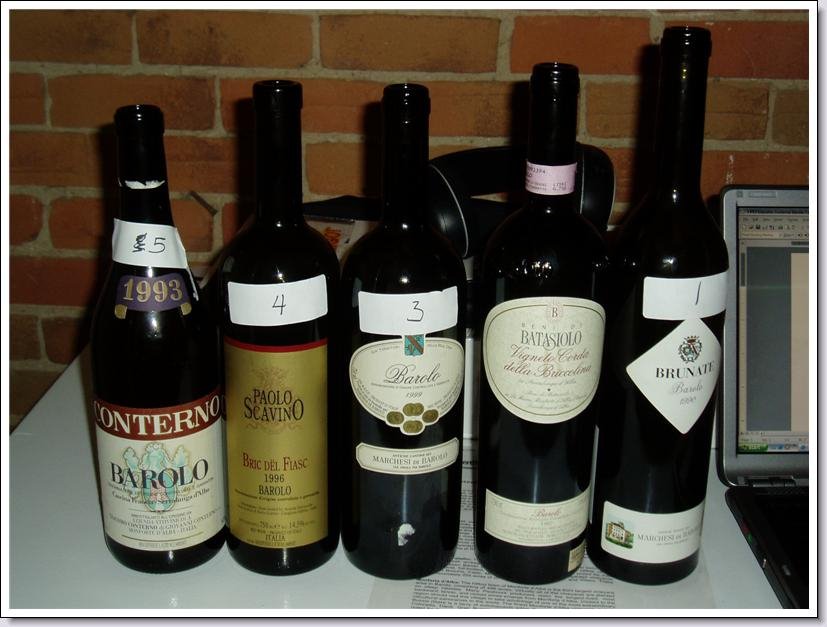
Age Matters: A Barolo Tasting

This tasting was less 'consensual' than many of our tastings, but there was a clear line between the three older wines and the two younger ones. The final tally was as follows:

First: 1990 Marchesi di Barolo Brunate
Pramod's wine was very consistent - six first place, four second place and one third place (me) ranking. I liked this wine, but I preferred the next two slightly better. On the nose the wine was pleasing, with scents of violet, pear, cherry, cedar, mushroom and tea. This medium-bodied Barolo was tannic, harsh and slightly unbalanced, and not as interesting on the palate as it was in the glass. In my mind the wine had peaked and is unlikely to improve, although it should drink well for a few more years. What lowered the score for me was not the taste, but the complexity - interesting, but less so (in my opinion) than the next two. Pramod claims C$86, putting it in the middle of the range.

Second: 1993 Giacomo Conterno Barolo "Cascina Francia"
This wine was VERY close to the wine above in overall ranking, and it was my favourite. A lovely, interesting nose of violets, cherry, vanilla, leather, hazelnuts, almonds and prunes. Medium- to full-bodied with firm tannins, it was very well balanced. Fruity, I described this as a more 'modern' Barolo, with potential for further improvement, despite the age. The most expensive of the evening at ~C$100. (RP-91)

Third: 1996 Paolo Scavino "Bric del Fiasc"
Scores for Lloyd's wine were very close to the previous wines, it was my second favourite. The nose was very aromatic, elegant and interesting, and earthy (cedar, truffles, mushrooms), with additional scents of leather, vanilla, tea and smoke. On the palate I described the wine as austere, with firm tannins and very well balanced, very Barolo. Lots of potential for further improvement, very nice. While the Conterno was my favourite, I would buy this one if I could find it, as the C$85 price seemed appropriate for such a nice young Barolo with so much potential. (RP-91 to 94)

Fourth: 1999 Marchesi di Barolo
Fairly consistently ranked fourth, myself included, although my tasting note sounds like this was the best wine of the night! The nose was elegant and pleasing, with a wide variety of subtle aromas - white flowers, cherry, mint, hay, mushrooms, leather, vanilla and smoke - I scored it highest for the nose. On the palate this medium-bodied Barolo had supple tannins, a smooth glyceriney texture and was very well balanced with a long finish. "Great now, and may get better. Lovely." Hmmm.

Fifth: 1997 Batasiolo Corda della Briccolina
Bringing up the rear was my Batasiolo. Thinking that the Barolos in my cellar are not yet ready, I decided to pick something up at the shop. Big mistake - pretty much everybody's least favourite, including my own! On the nose it was "Very hard to get past the alcohol and tannins". Scents of iodine, fuel. You get the picture. On the palate I described it as harsh, not well integrated, but will improve. Do you want to wait?

Comments:

1) Age Matters! It was a near linear relationship between age and ranking.
2) Note that those first three wines were ranked very close, while these last two were WELL behind. I believe if we did a rematch, any of the first three could have won.

It was nice to have a tasting away from my house - thank you to Reb and Cosme for hosting this tasting. Overall, a great (expensive) night - I look forward to the next one?